Boris Berenzon Gorn
0009-0000-2303-0526
Instituto Nacional de Antropología e Historia (México)
Abstract
This essay explores boredom as one of the central cultural symptoms of twenty-first-century capitalism through the philosophical lens of Slavoj Žižek and his dialogue with psychoanalysis, ideology critique, and digital culture. Drawing from works such as The Sublime Object of Ideology, Living in the End Times, and Welcome to the Desert of the Real, the text argues that contemporary capitalism no longer merely organizes labor and consumption; it colonizes attention, desire, and emotional life itself. In a civilization saturated with entertainment, notifications, and permanent stimulation, boredom has not disappeared. It has mutated into a hyperactive emptiness concealed beneath endless distraction. The essay proposes that digital culture fears boredom because boredom opens the possibility of silence, contemplation, and critical thought. Far from being a trivial psychological discomfort, boredom emerges here as a philosophical and political condition capable of exposing the hidden mechanisms of contemporary ideology.
Keywords: Boredom; Slavoj Žižek; ideology; digital culture; capitalism; psychoanalysis; attention economy; hyperstimulation; alienation; contemporary society
There were ages that produced heroes. Others produced saints. Ours produces entertained subjects.
The contemporary ideal no longer consists in attaining wisdom, justice, or spiritual redemption. It consists in remaining permanently stimulated. Digital civilization transformed distraction into a cultural virtue. Never before has humanity possessed so many mechanisms for escaping itself.
And yet boredom has rarely been so profound.
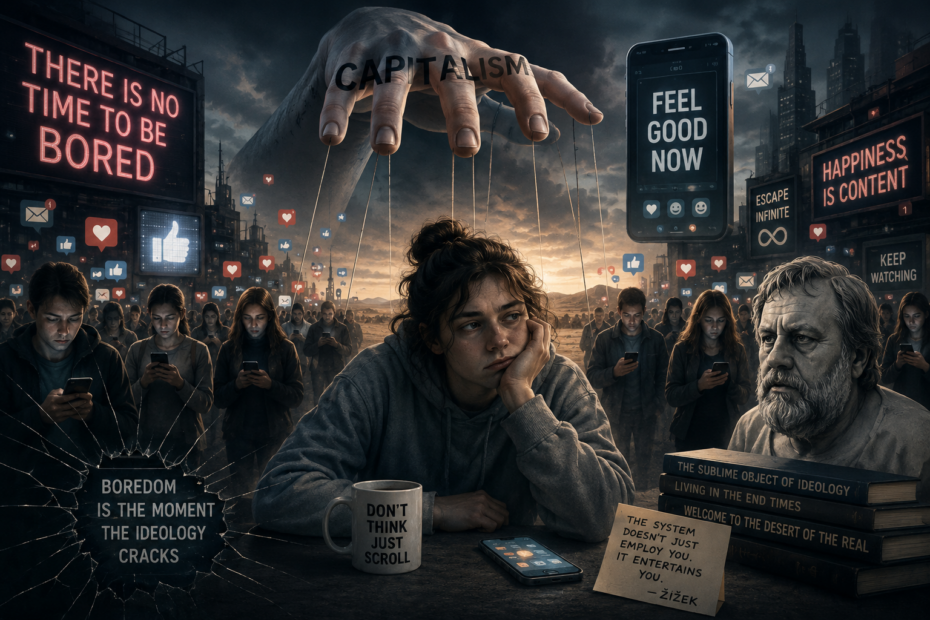
The paradox would have fascinated Slavoj Žižek. His entire body of work revolves around an unsettling intuition: contemporary capitalism no longer dominates merely through economic structures or political coercion. It governs by organizing desire, fantasy, emotion, and pleasure. The system no longer manages labor alone; it manages attention itself. It no longer sells objects alone; it sells ways of experiencing reality.
This is why boredom occupies such a central place within the cultural machinery of the twenty-first century.In The Sublime Object of Ideology, Žižek argues that ideology functions most effectively precisely when we believe ourselves to be free from it. The contemporary subject imagines itself autonomous, critical, liberated, endlessly capable of choosing between thousands of digital possibilities. That permanent sensation of freedom forms the very heart of a new servitude.
The ideological operation is extraordinary.
The modern individual no longer feels oppressed. The modern individual feels stimulated.
Late capitalism understood something decisive: a bored person who thinks too much may begin asking dangerous questions. For this reason digital culture eliminated nearly every empty space. People once waited by looking through windows, watching the street, surrendering themselves to wandering thoughts and useless contemplations. Today the pocket vibrates immediately like a small artificial organ demanding constant attention.
The smartphone became the perfect prosthesis against silence.
What is fascinating is the extent to which even emptiness itself has been colonized by the market. There are applications for sleeping better, breathing better, meditating better, relaxing better, disconnecting better. Even rest must perform. The contemporary subject no longer knows how to be bored because leisure itself has been transformed into a project of optimization.
Digital civilization converted entertainment into a moral obligation.
Living is no longer enough. Experience must also be documented, shared, and transformed into visible content. Breakfast must be photographed before being eaten. Travel appears to exist only after being uploaded online. Concerts matter as much for the vertical phone recording as for the music itself. Intimacy became spectacle. Narcissism found technological infrastructure.
Žižek would have recognized here one of the great ideological mutations of our era: the contemporary subject no longer requires permanent surveillance because it has learned to exhibit itself voluntarily.
Visibility became a form of existence.
In Welcome to the Desert of the Real, written in the aftermath of September 11, Žižek suggested that contemporary societies inhabit ideological simulations functioning as protection against traumatic reality. Something similar occurs today with digital entertainment. The endless stream of stimulation operates as a psychological barrier shielding individuals from fundamental questions concerning loneliness, mortality, emptiness, and meaninglessness.
Boredom emerges precisely when that barrier begins to crack.
This is why boredom generates such anxiety.
Contemporary boredom no longer resembles the silent tedium of nineteenth-century novels. It resembles instead a nervous, hyperactive, fragmented restlessness. The digital subject jumps frantically between applications, conversations, videos, newsfeeds, and platforms while sensing that almost nothing truly reaches them.
Never before have there been so many stimuli and so little existential intensity.
The cultural tragedy is brutal. Capitalism sells exciting experiences while producing deeply repetitive lives. The same applications. The same motivational phrases. The same overhead brunch photographs. The same emotional choreographies. The same recycled outrage endlessly circulated by algorithms transforming human emotions into commercial data.
Contemporary boredom emerges precisely from this invisible repetition.
Everything appears new. Everything feels identical.
Žižek repeatedly insists that capitalism possesses an extraordinary ability to absorb even the critiques directed against it. Authenticity became a premium commodity. Spirituality became industry. Meditation now appears sponsored by technological corporations. Rebellion transformed into advertising aesthetics.
The system discovered something extraordinary: even emptiness can be monetized.
An emotionally dissatisfied individual consumes more entertainment, more wellness products, more rapid experiences, more distraction platforms, more promises of authenticity. Late capitalism does not eliminate boredom. It administers it. It produces structural tedium and then sells mechanisms for surviving it.
Here Žižek’s thought acquires disturbing force. In his Lacanian framework, desire can never achieve definitive satisfaction because it is organized around a constitutive lack. Human subjectivity remains permanently incomplete. Capitalism exploits precisely this fracture by producing objects, images, and fantasies destined to fill a void that never entirely disappears.
This is why contemporary entertainment functions compulsively.
The individual no longer seeks pleasure alone. The individual seeks to avoid encountering itself.
Digital culture fears silence because silence might allow unbearable questions to emerge. Does this permanent acceleration possess any meaning? Why does hyperconnectivity coexist with growing loneliness? Why does the most entertained civilization in history also appear among the most anxious? At what moment did living begin to resemble the endless management of stimuli?
The technological industry understood very quickly that human attention had become the new cultural oil of the twenty-first century. Every second of contemplation represents economic loss. Every unproductive pause threatens the logic of digital consumption.
This is why platforms are designed to prevent sustained experiences of boredom.
Infinite scrolling. Autoplay. Constant notifications. Personalized recommendations. The algorithm functions as a digital version of the ideological unconscious described by Žižek. It organizes desire, emotion, and behavior without visible coercion. The subject believes itself free while unconsciously reproducing invisible patterns designed to maintain connection.
The operation is brilliant and devastating at once.
The contemporary individual no longer requires external chains because the mechanism of control already rests inside the pocket and is consulted compulsively every few minutes.
In Living in the End Times, Žižek describes societies perceiving signs of ecological, emotional, and economic collapse while continuing to behave as though nothing fundamental were occurring. Contemporary boredom can be understood precisely as one of the symptoms of this historical contradiction. The subject lives saturated with information and starved of meaning.
Everything moves too quickly to leave a profound mark.
News ages within hours. Political outrage lasts minutes. Trends disappear before consolidating themselves. Collective memory resembles an overloaded browser with too many tabs open simultaneously. Individuals consume industrial quantities of information while retaining very little meaningful experience.
Hyperstimulation ultimately produced emotional anesthesia.
Here emerges one of Žižek’s most unsettling insights: contemporary ideology triumphs not because it rationally convinces people. It triumphs because it organizes pleasure and distraction. The subject perfectly understands that endless screen exposure produces exhaustion, anxiety, and emotional fragmentation. The subject suspects that social media manipulates narcissism and fear. The subject recognizes that permanent entertainment functions as cultural anesthesia.
And yet participation continues.
This is the perverse core of digital capitalism.
The subject no longer needs to believe naively. It merely needs to remain connected.
Meanwhile boredom expands silently beneath the spectacle. A strange boredom. Hyperactive. Nervous. Incapable even of remaining still. The contemporary individual fears boredom because somewhere beneath the disappearance of noise there waits something more unsettling than tedium itself: emptiness.
Perhaps this is the true cultural catastrophe of our time.
Contemporary civilization does not fear boredom itself.
It fears what boredom might reveal.
Because a genuinely bored individual may suddenly stop. May observe critically the machinery organizing desire. May discover that many of its needs were artificially manufactured. May understand that hyperconnectivity does not necessarily produce community and that endless entertainment often functions as emotional management.
At that point boredom ceases to be a minor psychological inconvenience.
It becomes a philosophical possibility.
Perhaps this is why our era has done everything possible to eliminate it.
A civilization incapable of profound boredom eventually becomes incapable of profound thought. Thinking requires slowness. It requires pauses. It requires silence. Many of philosophy’s, literature’s, and art’s greatest works emerged precisely from moments in which subjects could linger before the world without immediate demands for productivity.
Our age distrusts every form of empty time.
Productive logic colonized intimacy itself. Sleep better. Breathe better. Love better. Rest better. Smile better. Everything must be optimized. Late capitalism transformed existence into an endless project of emotional self-exploitation.
And yet we continue participating.
We continue sliding our fingers across illuminated screens like elegant passengers aboard a digital Titanic while boredom quietly grows beneath the spectacle.
There, finally, emerges the truly uncomfortable question.
What would happen if we stopped fleeing boredom?
Perhaps we would discover something unbearable for contemporary culture: silence was never the enemy. The enemy was whatever the noise was trying to conceal.
References
Bauman, Z. (2000). Liquid modernity. Polity Press.
Benjamin, W. (2008). The work of art in the age of its technological reproducibility and other writings on media. Harvard University Press. (Original work published 1936).
Byung-Chul Han. (2015). The burnout society. Stanford University Press.
Byung-Chul Han. (2017). The scent of time: A philosophical essay on the art of lingering. Polity Press.
Debord, G. (1994). The society of the spectacle. Zone Books. (Original work published 1967).
Fisher, M. (2009). Capitalist realism: Is there no alternative? Zero Books.
Freud, S. (1961). Civilization and its discontents (J. Strachey, Trans.). W. W. Norton & Company. (Original work published 1930).
Heidegger, M. (1995). The fundamental concepts of metaphysics: World, finitude, solitude (W. McNeill & N. Walker, Trans.). Indiana University Press. (Original lectures delivered 1929–1930).
Lacan, J. (2006). Écrits: The first complete edition in English (B. Fink, Trans.). W. W. Norton & Company.
Marcuse, H. (1991). One-dimensional man: Studies in the ideology of advanced industrial society. Beacon Press. (Original work published 1964).
Marx, K. (1978). The eighteenth Brumaire of Louis Bonaparte. In R. C. Tucker (Ed.), The Marx-Engels reader (2nd ed., pp. 594–617). W. W. Norton & Company. (Original work published 1852).
Turkle, S. (2011). Alone together: Why we expect more from technology and less from each other. Basic Books.
Žižek, S. (1989). The sublime object of ideology. Verso.
Žižek, S. (2002). Welcome to the desert of the real!: Five essays on September 11 and related dates. Verso.
Žižek, S. (2008). Violence: Six sideways reflections. Picador.
Žižek, S. (2009). First as tragedy, then as farce. Verso.Žižek, S. (2010). Living in the end times. Verso.
Žižek, S. (2012). The year of dreaming dangerously. Verso.
Žižek, S. (2014). Trouble in paradise: From the end of history to the end of capitalism. Melville House. Žižek, S. (2017). The courage of hopelessness: Chronicles of a year of acting dangerously. Allen Lane.