Boris Berenzon Gorn
0009-0000-2303-0526
Instituto Nacional de Antropología e Historia (México)
Those who repeat critique without thinking it do not challenge power: they entertain it
Abstract
This essay examines the contemporary condition of Critical Theory as an intellectual practice increasingly shaped by institutional repetition, conceptual fatigue, and a pervasive affect of boredom. Rather than functioning as a disruptive form of social critique, Critical Theory often appears today as a stabilized academic language—recognizable, reproducible, and largely predictable. The central argument is that the crisis of Critical Theory is not primarily one of relevance, but of intensity: its capacity to disturb thought has been replaced by its capacity to circulate without friction within institutional and cultural systems.
Keywords: Critical Theory; boredom; academic repetition; institutional knowledge; universities; conceptual fatigue; novelty; Michel Foucault; Karl Marx; Max Horkheimer; Theodor W. Adorno; David Pastor Vico; Filosofía para desconfiados; epistemology; intellectual stagnation; cultural critique; ideology; modern academia; discourse; theory production; institutional absorption; intellectual risk; suspicion; knowledge circulation.
Introduction: From Disruption to Repetition
Critical Theory emerged historically as a form of intellectual interruption. In the work of Max Horkheimer and Theodor W. Adorno, it functioned as a negative mode of thinking: a refusal to accept social reality as self-evident.
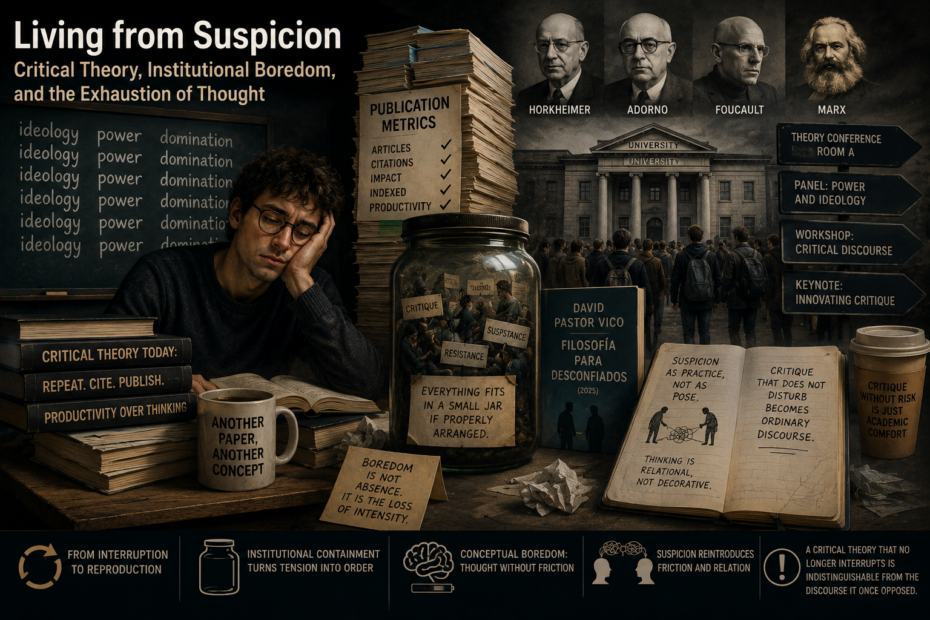
Today, however, Critical Theory is embedded in an epistemic environment saturated with its own vocabulary. Concepts such as ideology, power, and domination circulate widely, yet they rarely produce disruption. What once interrupted now repeats.
The result is a paradox: Critical Theory is everywhere, but it rarely disturbs anything.
Institutional Repetition and Conceptual Boredom
The modern university has become a central site for the reproduction of theoretical repetition. Within academic systems governed by publication pressure and productivity metrics, originality is often reduced to formal variation rather than conceptual rupture.
Even canonical thinkers such as Michel Foucault and Karl Marx are frequently reduced to simplified formulations, detached from the complexity of their original interventions.
This institutional logic produces what may be called conceptual boredom: a condition in which thought does not disappear but loses its capacity for interruption.
The Economy of Novelty and Intellectual Exhaustion
Contemporary academia demands constant innovation. However, this demand often produces only stylistic variation rather than epistemological transformation. Novelty becomes procedural: achieved through rephrasing, recombination, or interdisciplinary adjustment.
As a result, Critical Theory risks becoming a field of controlled variation, where differences are aesthetic rather than structural. The anticipation of arguments replaces their discovery.
Boredom, in this sense, is not accidental but structural.
The Affective Condition of Contemporary Critique
Boredom should be understood not as a subjective feeling but as an epistemological symptom. It emerges when thought ceases to interrupt and instead reproduces already known forms.
Critical discourse remains active in vocabulary but weakened in force. Terms like ideology or power continue to circulate, yet their capacity to unsettle perception has diminished.
The result is an intellectually saturated but affectively inert discourse.
The Contemporary Intellectual Subject
The contemporary academic thinker is shaped by contradictory demands: originality and recognizability, critique and institutional compatibility. This tension produces a form of intellectual subjectivity defined by cautious deviation.
Critical Theory thus becomes a repertoire of acceptable gestures rather than a mode of rupture.
David Pastor Vico: Suspicion as Practice
In contrast, David Pastor Vico, in Filosofía para desconfiados (2025), shifts attention from conceptual innovation to relational epistemology.
His proposal does not seek novelty but reactivation: suspicion is understood as an ethical practice rather than a stylistic position. Critique is valuable not for being new, but for sustaining tension with others and with oneself.
This approach reintroduces friction into a discourse increasingly defined by smooth circulation. Thinking becomes relational, situated, and conflictive rather than abstractly innovative.
The Risk of Neutralization
Even critical approaches are vulnerable to institutional absorption. Once integrated into academic circulation, even disruptive ideas risk becoming formulas, brands, or pedagogical tools.
The saying “everything fits in a small jar if properly arranged” captures this process. The “jar” symbolizes institutional containment: the transformation of tension into order, and critique into taxonomy.
Within this logic, Critical Theory becomes widely cited but rarely disruptive.
Conclusion: Boredom as Diagnostic Form
To engage Critical Theory today is not to adopt it as an identity marker but to recover its capacity for interruption. Its crisis is not one of disappearance but of intensity.
Boredom is therefore not a side effect but a diagnostic category. It signals the moment when critique ceases to disturb and becomes repetition.
A Critical Theory that no longer interrupts is indistinguishable from the discourse it once opposed.
References
Adorno, T. W., & Horkheimer, M. (2002). Dialectic of enlightenment: Philosophical fragments (E. Jephcott, Trans.). Stanford University Press.
Adorno, T. W. (2005). Minima moralia: Reflections from damaged life (E. F. N. Jephcott, Trans.). Verso.
Adorno, T. W. (2006). Aesthetic theory (R. Hullot-Kentor, Trans.). University of Minnesota Press.
Foucault, M. (1977). Discipline and punish: The birth of the prison (A. Sheridan, Trans.). Pantheon Books.
Foucault, M. (1990). The history of sexuality: An introduction (R. Hurley, Trans.). Vintage Books.
Habermas, J. (1984). The theory of communicative action: Volume 1 (T. McCarthy, Trans.). Beacon Press.
Horkheimer, M. (1974). Eclipse of reason. Continuum.
Marx, K. (1976). Capital: Volume I (B. Fowkes, Trans.). Penguin Classics. Vico, D. P. (2025). Filosofía para desconfiados. Editorial Ariel.