Boris Berenzon Gorn
0009-0000-2303-0526
Instituto Nacional de Antropología e Historia (México)
Abstract
This essay explores football as one of the most powerful symbolic and emotional structures of contemporary society through an interdisciplinary dialogue between anthropology, psychoanalysis, critical theory, and cultural history. Drawing on the thought of Slavoj Žižek, Karl Marx, and Sigmund Freud, the text argues that modern football operates not merely as entertainment, but as a sophisticated ideological apparatus capable of organizing collective desire, emotional belonging, and social catharsis within fragmented and emotionally exhausted societies.
The essay examines the relationship between football and the contemporary experience of boredom, suggesting that late capitalism administers emotional emptiness through mass spectacles that temporarily suspend anxiety, alienation, and existential fatigue. In this context, the FIFA World Cup emerges as a global ritual that synchronizes emotions across nations, transforming sport into a planetary liturgy mediated by technology, digital capitalism, and mass communication.
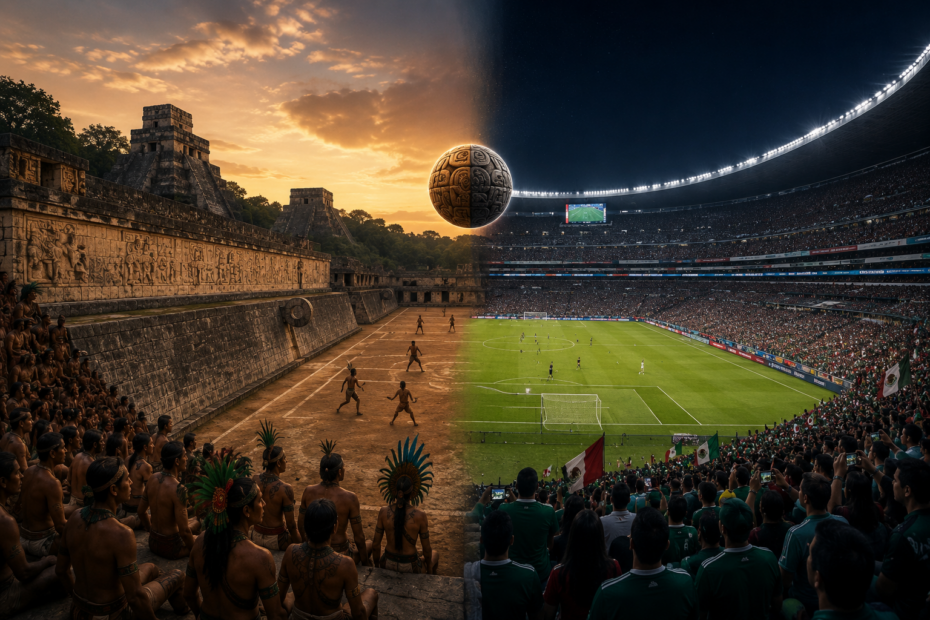
From an anthropological perspective, the essay traces symbolic continuities between modern stadium culture and ancient ritual practices, particularly the Mesoamerican ballgame represented in the Popol Vuh and archaeological sites such as Chichén Itzá and El Tajín. It also analyzes several FIFA World Cups as ideological mirrors of their historical moments, from fascist Italy in 1934 to hyper-mediated global capitalism in Qatar 2022 and the forthcoming 2026 World Cup hosted by Mexico, the United States, and Canada.
Ultimately, the essay proposes that football reveals the persistence of ancient ritual needs beneath the technological surface of modernity. The stadium functions simultaneously as spectacle, ceremony, emotional refuge, and symbolic battlefield where contemporary societies negotiate identity, memory, desire, and collective meaning.
Keywords
Football; Collective Unconscious; Ideology; Slavoj Žižek; Anthropology of Sport; Ritual; Boredom; Late Capitalism; FIFA World Cup; Mass Culture; Mesoamerican Ballgame; Emotional Communities; Spectacle Society; Psychoanalysis; Cultural Studies.
There are civilizations that organized their lives around pyramids, cathedrals, empires, or libraries. Ours chose to do so around a screen where twenty-two people chase a ball while millions scream as though the metaphysical destiny of humanity depended upon an offside call reviewed by VAR. There is something profoundly strange about a society more capable of debating a poorly awarded penalty than the price of gasoline, everyday violence, or environmental collapse. People unable to agree on how to improve their own neighborhoods can spend hours defending a Uruguayan striker who will never know they exist. Entire families alter the emotional atmosphere of a Sunday according to the accidental rebound of a ball. Modernity promised rational citizens and ended by producing crowds that insult their televisions as though the referee could truly hear them from an air-conditioned booth in Doha, Berlin, or Mexico City.
Football achieved something neither politics, philosophy, religion, nor the pedagogical campaigns of modern civility ever fully managed to accomplish: the instantaneous manufacture of emotional belonging within deeply fragmented societies.
Here emerges Slavoj Žižek, that Slovenian thinker who resembles a coach permanently expelled from an eternal match: disheveled, excessive, ironic, half Balkan Marxist and half football commentator possessed by a Freudian psychoanalyst. His most uncomfortable intuition is deceptively simple: ideology does not function because people are naïve. It functions because they enjoy participating in it. Contemporary football may well be the most perfect laboratory of that emotional machinery.
Karl Marx discovered that commodities do not merely circulate: they enchant. Capitalism transforms ordinary objects into magical entities capable of concealing the social relations that produce them. Sigmund Freud observed something similar in dreams: the problem was never simply uncovering what is repressed, but understanding the structure that makes illusion itself possible. Žižek unites both paths and carries them directly into the stadium. There he encounters a brutal truth: the contemporary supporter knows perfectly well that football is traversed by gigantic corporations, betting houses, money laundering, political propaganda, emotional marketing, and multimillion-dollar business interests. He knows it. He creates memes. He criticizes FIFA. He denounces corruption. He posts moral outrage on social media. Then he buys the special-edition jersey, pays for four streaming platforms, and emotionally reorganizes his existence around the tournament schedule.
That is precisely perfect ideology.
It is not a lie imposed from above. It is an emotional structure organizing desires, pleasures, and forms of belonging. The contemporary subject no longer believes innocently. He believes cynically. He says, “everything is rotten,” while preparing to suffer through a derby with an intensity the ancient Greeks reserved for tragedy itself.
Football has thus become a kind of religion without a fixed god and with far too many sponsors.
There is another element even deeper and less visible: boredom.
Not the superficial boredom of someone waiting for a bus while staring at a phone. Not the banal tedium of a rainy afternoon. Something else entirely is at stake: the existential exhaustion produced by societies in which everything moves too quickly and almost nothing leaves a lasting emotional mark. Endless offices. Suffocating urban commutes. Precarious labor. Infinite screens. Permanent notifications. Absurd meetings. Emails sent with counterfeit urgency. Algorithms capable of deciding what we desire before we ourselves formulate the desire.
Late capitalism promised permanent entertainment and ended by manufacturing exhausted, hyperconnected, emotionally anesthetized subjects.
It is there that football appears as an interruption of emptiness.
Ninety minutes capable of restoring emotional density to lives administered by schedules, metrics, digital platforms, and financial anxiety. During an important match, ordinary time is suspended. Existence momentarily ceases to resemble an endless sequence of bureaucratic procedures. People once again feel tension, hope, fury, fear, euphoria, and shared tragedy. Football does not eliminate contemporary boredom: it organizes it collectively in order to render it bearable.
That is why World Cups generate such disproportionate emotions.
For several weeks, the planet seems to abandon industrial monotony and enter a different temporality, almost carnivalesque in nature. Cities change rhythm. Working hours are altered. Offices fill with clandestine screens. Airports become global processions. People incapable of sharing an ideology embrace each other for ten seconds after a goal. Football achieves what very few contemporary structures can still accomplish: the creation of experiences of massive emotional synchrony.
Žižek would likely argue that one of the most sophisticated forms of contemporary ideological enjoyment emerges precisely there. Boredom is no longer confronted through political transformation, profound communal experience, or the construction of historical meaning. It is administered through spectacles capable of producing temporary catharsis. The World Cup thus functions as a gigantic planetary machine of emotional suspension in which millions momentarily forget precariousness, uncertainty, and the exhaustion of contemporary life.
Anthropology would immediately recognize the magnitude of the phenomenon.
Long before the emergence of modern states, societies constructed collective rituals to organize fear, violence, memory, and social cohesion. Agricultural festivals, ceremonial dances, medieval carnivals, religious pilgrimages, ritual sacrifices, and symbolic wars were never mere entertainments. They functioned as profound mechanisms of social integration. They allowed communities to recognize themselves even amid chaos.
The modern stadium preserves something of all those spaces.
It is simultaneously temple, Roman amphitheater, tribal ceremony, and political theater. Hymns emerge there, sacred colors, heroic narratives, hereditary enemies, collective choreographies, and moments of emotional communion recalling ancient forms of symbolic organization. The supporter does not merely attend to “watch sport.” He participates in a contemporary liturgy through which identities are reaffirmed, frustrations channeled, and the illusion of belonging to something larger than oneself is experienced.
And in Mexico that experience acquires an even deeper antiquity.
For beneath the roar of the modern stadium still resonates the distant echo of the Mesoamerican ballgame.
That echo remains, even when unnoticed.
Long before global sponsors, satellite broadcasts, and hysterical commentators, Mesoamerican civilizations had already understood that play itself could become a ritual representation of the cosmos. The ballgame was not merely physical competition: it was political ceremony, astronomical representation, religious theater, and symbolic dramatization of life and death. The movement of the ball evoked the movement of celestial bodies. The field reproduced the order of the universe. Players represented cosmic forces held in tension.
The ball itself possessed profound symbolic meaning. It bounced like the sun crossing the sky, descending into the underworld and returning again at dawn. In some Mesoamerican narratives, the game represented the eternal struggle between forces of life and death. Players embodied cultural heroes capable of sustaining cosmic equilibrium through sacrifice and ritual confrontation.
The Popol Vuh preserves part of that memory. The twins Hunahpú and Ixbalanqué challenge the powers of the underworld precisely through the ballgame. There, the game appears as cosmic drama, metaphysical combat, and representation of the continuity of life itself. It is no coincidence that many ceremonial Mesoamerican spaces placed their courts beside temples and ritual centers. The game articulated religion, politics, and community.
At sites such as Chichén Itzá, El Tajín, Monte Albán, or Cantona, ball courts formed the central axis of urban complexes where political and spiritual order was publicly represented. The audience did not merely observe a match: it attended a representation of the universe itself.
There is something unsettling in that historical continuity.
The contemporary stadium appears completely secularized, digital, modern. It is filled with advertisements for industrial beer, international banks, cryptocurrencies, and betting platforms. Yet it still preserves an ancient emotional structure. Multitudes continue gathering to experience tension, hope, symbolic sacrifice, and collective catharsis. The gods changed. The architectures changed. The rules changed. The collective unconscious continues searching for ceremonies.
Every World Cup ultimately reveals something far deeper than sporting results. It functions as an emotional radiography of its historical moment.
1934 FIFA World Cup displayed the totalitarian use of spectacle under the fascism of Benito Mussolini. 1978 FIFA World Cup transformed football into propagandistic scenery while the dictatorship disappeared people only kilometers from the stadiums. 1994 FIFA World Cup inaugurated the fully televised and commercial World Cup designed for global markets and advertising schedules. 2010 FIFA World Cup attempted to embody the optimistic narrative of post-apartheid reconciliation through planetary spectacle. 2022 FIFA World Cup exhibited the most sophisticated form of contemporary capitalism: hyperinfrastructure, oil wealth, global diplomacy, technological surveillance, and total entertainment gathered into a single symbolic apparatus.
Each World Cup also leaves behind figures transformed into cultural mythologies.
Pelé condensed the optimistic modernity of the twentieth century. Diego Armando Maradona represented Latin American excess, the symbolic revenge of the Global South, and the tragedy of the popular hero devoured by his own intensity. Zinedine Zidane transformed a headbutt in Berlin 2006 into one of the most studied gestures of contemporary fury. Lionel Messi became a narrative of late redemption for an era obsessed with statistical performance and algorithmic perfection.
World Cups produce heroes because societies continue needing epic narratives.
In an age where almost everything appears fragmented, ironic, and ephemeral, football still offers simple and powerful stories: victory, defeat, sacrifice, fall, redemption, and glory. The ball preserves something politics lost long ago: the capacity to fabricate shared emotional narratives on a planetary scale.
Mexico knows that experience intimately.
The World Cups of 1970 FIFA World Cup and 1986 FIFA World Cup were not merely sporting events: they functioned as gigantic symbolic mirrors of the nation itself.
The 1970 tournament appeared as Mexico’s definitive entrance into the global televised spectacle. The country displayed monumental stadiums, architectural modernity, and organizational capacity while attempting to project political stability only a few years after the open wound of 1968. Cameras transmitted a luminous, festive, cosmopolitan country. Football helped construct an emotional narrative of national modernity.
The Estadio Azteca became a kind of global temple. There, Pelé appeared less an athlete than a mythological figure. His presence condensed something almost religious. Football acquired planetary dimensions while television discovered the hypnotic power of mass spectacle broadcast in real time.
The 1986 World Cup possessed another historical texture entirely.
It arrived after the 1985 earthquake, when Mexican society had discovered both institutional fragility and the extraordinary force of civic solidarity. That tournament became marked by a strange mixture of mourning, reconstruction, and collective need for joy. Maradona then became an almost mythical figure. His goal against England condensed far more than footballing talent: for millions it represented a small poetic revenge of the Global South against old imperial powers.
The famous “Hand of God” even possesses a profoundly anthropological dimension. Ritualized fraud, the cunning of the popular hero, the admired trickster who defeats the powerful through audacity: all of this belongs to older Latin American cultural narratives as well. Maradona was never perceived merely as a player; he emerged as a modern trickster, an ambiguous figure capable of challenging established order through genius, excess, and transgression.
Mexican football memory is filled with scenes where sport and collective unconscious intertwine. The Azteca ceased to be merely a stadium; it became the emotional archive of the nation itself. There coexisted televised modernity, popular epic, sentimental nationalism, and global business.
That is why the 2026 FIFA World Cup appears so fascinating from a cultural and anthropological perspective.
Mexico will once again host the tournament in a radically different era. It is no longer simply about stadiums and television broadcasts. The tournament will now unfold amid artificial intelligence, social media, digital betting, sports influencers, and platforms capable of converting any emotion into commercializable data.
The old tribal ritual will be broadcast in real time through technological systems measuring emotional reactions second by second. The goal will no longer merely be screamed inside the stadium: it will instantly become trend, meme, commodity, and statistical information.
The coming World Cup will also function as a gigantic ideological showcase of contemporary capitalism. Entire cities will transform themselves to receive global tourists. Football will temporarily reorganize urban space, consumption, and public life. Discourses concerning national identity, inclusion, and collective pride will be sponsored by corporations fully aware of the commercial value produced by tears shed before a penalty kick.
And yet millions will once again feel genuine emotion.
Therein resides the central paradox Žižek understood better than almost anyone else: the most powerful ideology is not the one compelling belief in falsehood. It is the one organizing our enjoyment.
Football does not function merely because it manipulates from outside. It functions because it produces authentic emotions. The goal truly moves people. The collective embrace truly exists. Joy is not false. Precisely for that reason the mechanism proves so effective. Contemporary capitalism understood something decisive: the most sophisticated domination does not eliminate pleasure; it administers it.
Perhaps that is why football matters so profoundly.
Not because it is trivial, but because it reveals with surgical precision what we are: exhausted societies, emotionally famished, profoundly in need of collective rituals. The stadium offers a fleeting community where strangers may still embrace one another without requiring prior ideological explanation.
Perhaps therein lies the most accurate image of our age: millions shouting before a screen, convinced they are experiencing an entirely free passion while algorithms, corporations, and digital platforms calculate in real time the commercial value of every tear, every insult, and every celebration.
Perhaps the secret of contemporary football does not reside solely in spectacle. Perhaps its true power lies elsewhere: for ninety minutes it allows millions to forget the unbearable weight of a life increasingly administered, surveilled, and bored. The ball does not eliminate the contemporary void. It illuminates it with floodlights, hymns, and gigantic screens so that we may endure it together.
Perhaps the ball merely modernized a far older necessity. We exchanged ritual drums for high-definition broadcasts. We replaced cosmic ceremonies with televised playoffs. We substituted the echo of the Mesoamerican ballgame with the digital roar of global stadiums.
The unconscious, far less modern than ourselves, never noticed the difference.
References
Bauman, Z. (2003). Modernidad líquida. Fondo de Cultura Económica.
Debord, G. (1995). La sociedad del espectáculo. Pre-Textos.
Durkheim, É. (2012). Las formas elementales de la vida religiosa. Fondo de Cultura Económica. (Obra original publicada en 1912).
Foer, F. (2005). Cómo el fútbol explica el mundo. Debate.
Frazer, J. G. (2011). La rama dorada: Magia y religión. Fondo de Cultura Económica.
Freud, S. (2010a). El malestar en la cultura. Alianza Editorial. (Obra original publicada en 1930).
Freud, S. (2010b). Psicología de las masas y análisis del yo. Alianza Editorial. (Obra original publicada en 1921).
Freud, S. (2011). Tótem y tabú. Alianza Editorial. (Obra original publicada en 1913).
Han, B.-C. (2012). La sociedad del cansancio. Herder.
Han, B.-C. (2014). Psicopolítica: Neoliberalismo y nuevas técnicas de poder. Herder.
Huizinga, J. (2014). Homo ludens. Alianza Editorial. (Obra original publicada en 1938).
Kirchhoff, P. (1968). El juego de pelota mesoamericano. Instituto Nacional de Antropología e Historia.
Kuper, S., & Szymanski, S. (2018). Soccernomics. Nation Books.
Lévi-Strauss, C. (2002). Mitológicas I: Lo crudo y lo cocido. Fondo de Cultura Económica.
Popol Vuh. (2017). Popol Vuh: Las antiguas historias del Quiché. Fondo de Cultura Económica.
Ramonet, I. (2003). La tiranía de la comunicación. Debate.
Turner, V. (1988). El proceso ritual: Estructura y antiestructura. Taurus.
Veyne, P. (1984). Pan y circo: Sociología histórica de un pluralismo político. Siglo XXI Editores.
Villoro, J. (2006). Dios es redondo. Anagrama.
Villoro, J. (2014). Fútbol y patria. Debate.
Whittington, M. E. (Ed.). (2001). The sport of life and death: The Mesoamerican ballgame. Thames & Hudson.
Žižek, S. (2003). El sublime objeto de la ideología. Siglo XXI Editores.
Žižek, S. (2005). Bienvenidos al desierto de lo real. Akal. Žižek, S. (2011). En defensa de la intolerancia. Sequitur.